Sample text 123
Business Administration
Business administration students at CMU-Q learn quantitative decision-making, our pioneering approach to undergraduate business education.
Bachelor of Science in Business Administration
Business administration at Carnegie Mellon is a leader at the intersection of business, technology, and analytics. This emphasis on interdisciplinary collaboration offers a dynamic 21st-century undergraduate business education.
The Carnegie Mellon curriculum emphasizes an analytical approach to decision-making in business. As they build a solid quantitative foundation, students learn to work with data and apply their analyses to real-world scenarios.
Business administration students have identical graduation requirements as students at Carnegie Mellon in Pittsburgh. Graduates have CMU degrees, conferred from the main campus.


“CMU-Q has pushed me to be where I am today. The quality of the faculty and staff, best in the world, the warm community between these walls, and the culture of diversity transforms your inner potential to tangible reality.”
Saleh Al-Raisi, Class of 2014, Chief Commercial Officer, Nakilat
Program at a Glance
With an emphasis on analytics and leadership development, students are prepared for the challenges of the global business landscape.
Students explore five main areas during their degree programs:
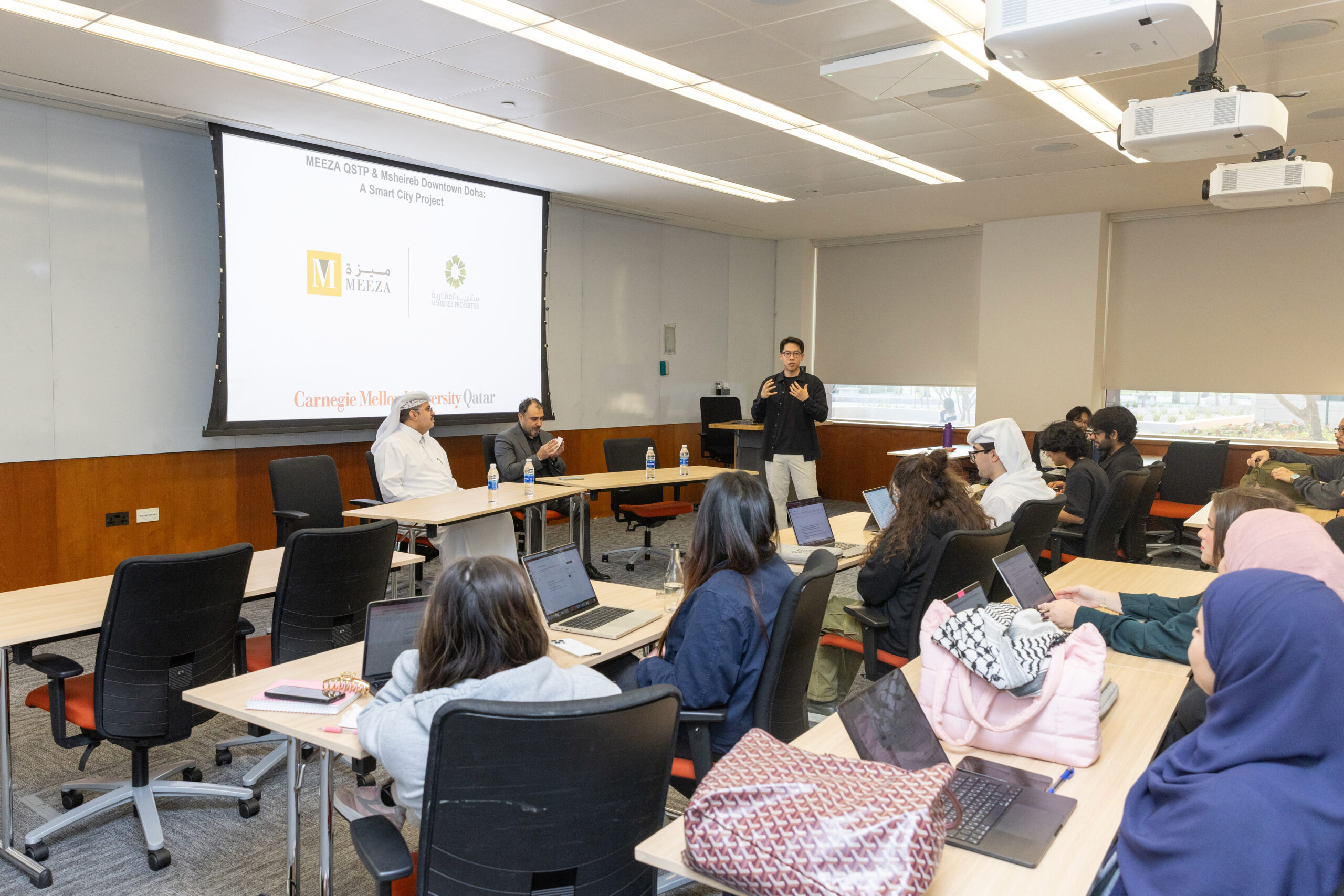
Through project courses, internships, and leadership development activities, students put into practice the knowledge they learn in the classroom.
Most students pursue internships in organizations around Qatar, applying the knowledge they learn in the classroom to real-world scenarios.

“The strong alumni network not only allows me to connect with alums in similar positions and learn from their experiences, but I can gain insights from alums in different positions and different industries and learn about their professional ecosystems.”
Farha Khan, Class of 2018, MBA Candidate, Stanford University
The Bachelor of Science in Business Administration curriculum builds foundational knowledge in the core areas of business, including marketing, finance, organizational behavior and operations management, as well as economics, mathematics, and statistics. Concentration areas allow students to delve into their choice of specific business areas. Students develop breadth and context through a required minor and general education coursework.
The first year of the curriculum builds a foundation of skills for analysis, communication, and context through courses in business science, economics, quantitative skills development, and the liberal arts.
The next two years develop the core competencies, as students delve into a focus area and select a minor. The last year is for in-depth study in the focus area and completing the minor requirement.
The classroom education is brought to life through a variety of projects, project courses, internships, and leadership development. Students learn how to apply the knowledge and skills they have learned, giving them the confidence to begin and develop their careers over a lifetime.
Standard Completion Time: 4 Years
Business administration students must complete a minor and a business concentration.
The minor must be in a second field of study, and students can choose from several options delivered at the Qatar campus. Students are encouraged to explore their interests, and to develop an understanding of the world beyond business administration.
Concentration areas allow students to gain knowledge and expertise in a specific area of business practice. Concentrations include:
*This concentration has some requirements that must be completed at the Pittsburgh campus.
CMU-Q continually examines the course offerings in business to ensure students are learning the skills they will need in the workplace. New courses are often added to cover important topics for business professionals in the Gulf region.
New offerings:
Career Pathways
Graduates in business administration are highly sought after and pursue careers such as financial reporting analyst, management consultant, executive director, economics researcher, markets and clients executive, and corporate and markets analyst.
Region
Meet the Faculty
Faculty members include experts in fintech, algorithmic trading, mathematical/statistical modeling, Islamic finance, entrepreneurship, political economy, revenue management, supply chain, business applications of AI, machine learning and deep learning.

Simon Faulkner
Assistant Teaching Professor, Chemistry

Amirah Mohamed Al Sarraj
Library Associate, Collection

Mohammed Al-Sadi
Teaching Assistant, Information Systems

Sara Al Sabbagh
Teaching Assistant

Dina Al Abdi
Program Director of Student Engagement

Mohammed Al-Sadi
Teaching Assistant, Information Systems

Mohamed Al Khudari
Receptionist and Administrative Coordinator