Sample text 123
Computer Science
The computer science program at CMU-Q equips students with a strong theoretical foundation in computer science so they can remain current as technologies and systems change.
Bachelor of Science in Computer Science
Carnegie Mellon University in Qatar follows the curriculum of the CMU School of Computer Science. One of the first computer science schools in the world, the School of Computer Science consistently ranks among the top computer science programs.
Students in the computer science program acquire skills that transcend technological trends. The program encourages teamwork and communication in both technical and multi-disciplinary contexts.
Computer science students have identical graduation requirements as students at Carnegie Mellon in Pittsburgh. Graduates have CMU degrees, conferred from the main campus.

“That is where we as CMU-Q grads have an advantage. Our education hasn’t been about specific content, but how to learn, think and problem-solve.”
Sabih Bin Wasi, Class of 2015, Founder and CEO, Stellic
Program at a Glance
Since computing is a discipline with strong links to many fields, the Carnegie Mellon program gives students unparalleled flexibility to pursue their interests.
The computer science degree at CMU-Q includes:
Students at CMU-Q have many opportunities to engage in research, including a senior thesis project, independent study, or internships with a CMU-Q research group.
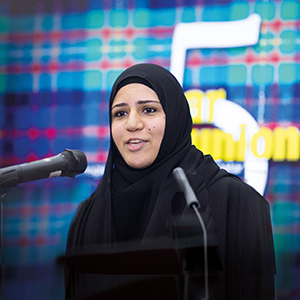
“It’s so interesting to see how my classmates are rising and taking key roles across several industries. I am certain that CMU-Q graduates will only continue the rise to leadership.”
Nora Al-Subai, Class of 2008 Business Solutions Manager, QatarEnergy
“It’s so interesting to see how my classmates are rising and taking key roles across several industries. I am certain that CMU-Q graduates will only continue the rise to leadership.”
Nora Al-Subai, Class of 2008 Business Solutions Manager, QatarEnergy
The Bachelor of Science in Computer Science curriculum provides students with a core set of skills: mathematical reasoning, algorithmic thinking, and the fundamentals of programming.
Through mathematics and probability courses, students develop the formal foundations to remain current as technologies change. Intensive project-oriented courses provide insight into the practical issues of building and maintaining systems, and a required minor or concentration offers substantial depth in a second field.
Standard Completion Time: 4 Years
The Carnegie Mellon computer science curriculum provides a common, solid foundation. Students are then encouraged to obtain in-depth knowledge in specific areas of computer science based on their interests.
Artificial Intelligence and Robotics
Many traditional roles are being automated so they can be done more safely and efficiently. Different areas of computing merge to enable technologies that include industrial automated factories, disaster area navigation and driverless vehicles.
Big Data and Machine Learning
Many applications, businesses, and scientific disciplines must collect, store, clean and analyze massive amounts of data. Students learn machine learning techniques to extract information, create large-scale database management systems, and leverage cloud systems and architectures to process this information.
Robust and Secure Systems
Security is a critical area in our fully connected world. Students develop a solid understanding of the system software, including device operating systems, networked systems and protocols, and fundamental distributed systems challenges.
Cutting-edge Applications
Many applications have become so popular that they are now sub-disciplines within computer science, including web applications, natural language processing, and computational biology.
Theory and Logic
Knowing how to program is the first step; knowing how to program well is the next challenge. Theory and logic courses explore areas such as sequential and parallel algorithms, complexity, languages and automata and graph theory.
Programming Paradigms
Programming is our way of communicating with computers and a basic tool for every computer scientist. At CMU-Q, students learn how to program imperative, functional and object-oriented paradigms, with emphasis on proving programs correct.
Students in the Computer Science Program acquire skills that transcend technological trends. The program encourages creativity and provides the fundamental skills to develop new technologies.
This is a small sample of course projects that CMU-Q students have worked on:
Career Pathways
Graduates find work as software engineers, Artificial Intelligence (AI) engineers, machine learning specialists, network architects, data scientists, cybersecurity engineers or roboticists. They can also work in emerging fields such as language technology, computational biology, human-computer interaction and robotics.
Region
Meet the Faculty
Faculty members include experts in Artificial Intelligence, cloud computing, computational morphology, cybersecurity, database management systems, mobile and pervasive computing, natural language processing, parallel computer architectures, and wireless embedded systems.

Simon Faulkner
Assistant Teaching Professor, Chemistry

Amirah Mohamed Al Sarraj
Library Associate, Collection
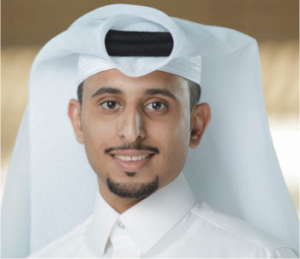
Mohammed Al-Sadi
Teaching Assistant, Information Systems

Sara Al Sabbagh
Teaching Assistant

Dina Al Abdi
Program Director of Student Engagement

Mohammed Al-Sadi
Teaching Assistant, Information Systems
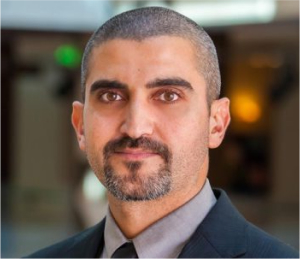
Mohamed Al Khudari
Receptionist and Administrative Coordinator